

External Flush Design for Mechanical Seals
Why proper engineering—not just Plan 32—makes the difference between flushing and flushing effectively.
Keith Toal, Paradigm Seals
This article was originally published by Pumps & Systems magazine.
Read the published version here: Pumps & Systems-External Flush
In many plants, installing an external flush for a mechanical seal still means little more than connecting a water line and hoping it will keep the seal clean, cool and lubricated. While an external flush—often referred to as Plan 32—can significantly improve seal reliability in difficult services, simply introducing clean fluid into the seal chamber (stuffing box) does not guarantee the seal is being properly protected. In many applications, the primary concern is abrasive particles in the pumped fluid that can rapidly wear the seal faces if they are allowed to reach the sealing interface. Too little flush may fail to control temperature or purge contamination, while too much can waste water and still fail to create the right environment at the seal faces. Effective flushing requires more than a connection point. It requires proper engineering of the flush system to ensure the right fluid reaches the seal faces in the right way and in the right amount.
What an External Flush (Plan 32) Is Intended to Do
An external flush is commonly used to keep contaminants—such as abrasive solids—away from the seal faces to prevent wear and extend seal life. These contaminants can also damage the seal by causing hang-up or clogging of the springs. External flushing may also be used for heating or cooling when the pumped fluid cannot be conditioned through other piping plans to provide a suitable seal environment.
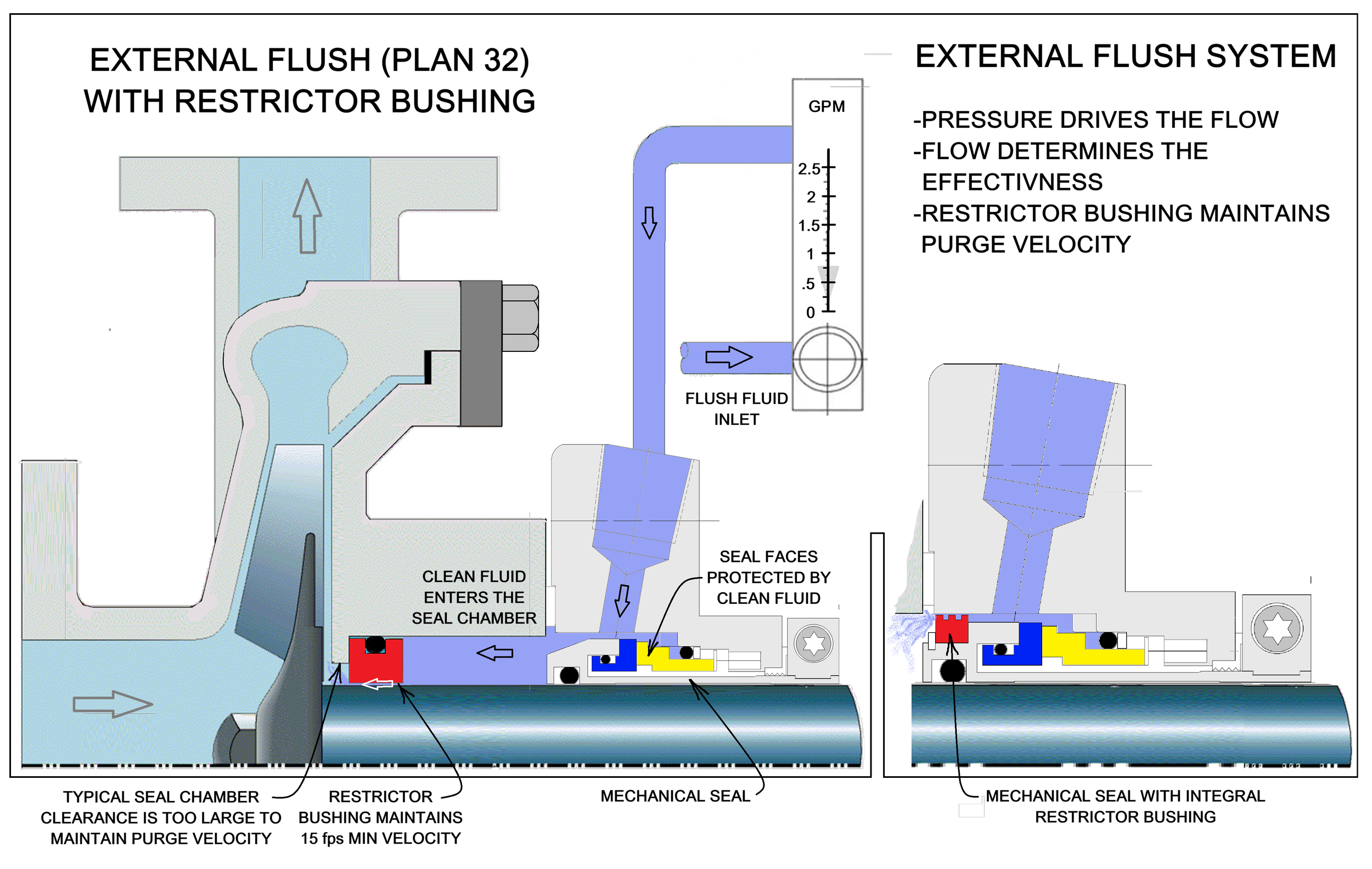
In an external flush arrangement, a clean fluid is piped directly to the mechanical seal flush port where it enters the seal chamber. The intent is for the clean fluid to create a controlled environment around the seal faces before eventually exiting the chamber and mixing with the pumped process fluid. When properly applied, the flush helps maintain a cleaner and more stable environment for the seal faces.
Choosing an External Fluid
Because the external flush ultimately mixes with the pumped process fluid, it must be compatible with the process. The fluid must also be capable of providing a clean and cool environment to properly lubricate the seal faces and improve seal life.
In water-based processes—such as paper mills or water and wastewater facilities—the flush fluid is typically clean water supplied from plant service water or city water. In processes using other fluids, finding a compatible external flush can be more challenging. In some cases, a nearby process stream may provide a suitable option. For example, a downstream process may contain the same base fluid but has already been filtered or cooled, making it more suitable for use as a seal flush.
External flushing also introduces operating costs. The cost of the fluid itself, evaporation losses, and potential impacts on process capacity can all add up. However, when the flush system is properly engineered, these costs can often be minimized while still providing an effective seal environment.
Why Simply Adding Pressure Isn’t Enough
A common rule of thumb for external flush systems is to supply flush fluid at 15-25 psi above seal chamber pressure. While this approach can ensure that clean fluid enters the seal chamber, it does not necessarily result in an effective flush. Seal chamber pressure itself can vary widely depending on pump design and operating conditions.
An uncontrolled flush with a 25 PSI differential can easily result in flow rates of 5–10 gallons per minute or more. In many applications, however, the flush system can be engineered to reduce this flow to less than 0.5 GPM while still providing effective protection for the seal.
The key factor is flow, not pressure. Differential pressure is simply the driving force required to deliver the amount of flush fluid needed. When the flush system is properly engineered, the pressure differential only needs to be high enough to achieve the required flow rate.
The first step is determining the flow required to keep the seal operating clean and cool. Two factors must be considered: removing heat generated at the seal faces and purging contaminants from the seal chamber. The flow required for cooling depends on several variables, including the properties of the flush fluid, seal chamber pressure, pump speed, seal size and face materials. Your seal supplier can often help estimate the cooling flow requirement.
Contaminant control is the second factor. To effectively prevent solids from reaching the seal faces, the flush fluid must maintain a clean environment in the seal chamber. In many cases, this can be achieved while using significantly less flush fluid by controlling how the flush exits the chamber, such as through the use of a restriction device.
Containing the Flush Where It Matters
By installing a restrictor bushing at the bottom of the seal chamber where the flush fluid exits, the amount of flush required to protect the seal can be substantially reduced. Restrictor bushings are available from most seal suppliers and are also incorporated as integral components in some cartridge seal designs.
To prevent contaminants from entering the seal chamber, the flush fluid must exit the chamber at a sufficient velocity to keep process fluid from migrating back toward the seal faces. A commonly accepted guideline is a minimum velocity of approximately 15 feet per second through the exit clearance. Too little flow can allow contaminants to mix back into the seal chamber, while excessive flow only increases the cost of operating the flush system.
The clearance at the bottom of many seal chambers is often too large to achieve this velocity without excessive flush flow. In some cases, pumps use open-bore seal chambers that make it nearly impossible to maintain the required purge velocity. Installing a restrictor bushing with a controlled clearance—typically in the 0.005–0.010 inch range-allows the required exit velocity to be achieved with significantly lower flow.
Once the required flow for purging contaminants is determined, it should be compared with the flow required for seal face cooling. The greater of these two values represents the minimum flush flow required for the application.
Controlling and Monitoring the Flush
The final step is to install a flow control device that allows the flush flow to be adjusted and monitored. A manual flow meter is the most common device used for this purpose. These devices typically incorporate a needle valve that restricts the flow by changing the orifice size, creating a pressure drop that allows the flow rate to be adjusted.
The higher flush supply pressure—often in the range of 15–25 psi above seal chamber pressure—provides the differential pressure needed for the flow meter to control and adjust the flush flow. If pressure fluctuations are expected within the pumping system, it is good practice to include a small safety factor when establishing the required flush flow to ensure adequate cooling and contaminant purging under varying operating conditions.
Another device that may be considered is an inline flow regulator. These devices use an internal flexible orifice that automatically adjusts as pressure changes, helping maintain a relatively constant flow rate even when supply pressure varies.
Figure 1. External flush system with restrictor bushing used to maintain purge velocity.
Engineering an Effective Flush System
Designing an effective external flush system requires more than simply supplying clean fluid to the seal chamber. The goal is to create a controlled environment around the seal faces that keeps contaminants away, removes heat generated by the seal faces and does so while using only the amount of flush fluid necessary to achieve these objectives.
An effective flush system begins by determining the flow required to cool the seal and purge contaminants from the seal chamber. Containing the flush fluid within the chamber using a restrictor bushing allows the required purge velocity to be achieved with much lower flow rates than would otherwise be required. Once the proper flow has been determined, a flow control device such as a flow meter or flow regulator can be used to adjust and maintain that flow during operation.
When these elements are properly engineered, the flush system can provide a clean, stable environment for the seal faces while minimizing flush fluid consumption and the associated operating costs.
Ultimately, successful flushing is not simply a matter of supplying fluid to the seal chamber. It’s not just that you’re flushing=it’s whether you’re flushing effectively.
Originally published in Pumps & Systems.
Read the original article here: Pumps & Systems-External Flush
